
Flourish
"Flourish" is sometimes used to describe an extra touch, a little dash of extravagance, but it is not - it is essential

Key leadership questions are not the ones that get asked first.
Usually, the concerns are immediate. The alleviation of some pain. How to bridge a specific deficit in resources or talent. Valid and urgent as those questions are, they are not the most important ones.
As a process consultant, I can’t tell you how to make better and cheaper widgets. But, what if leadership were to focus on creating space for human beings to flourish, would you get better widgets? And better widget making workers, too?
Aristotle framed his ethics around a different set of principles. Often, ethics gets limited to dos and don’ts. John Stuart Mill and Jeremy Bentham introduced utilitarian calculations and the probability of a positive outcome. In overly simplistic terms, two wrongs can make a right. If the outcome is good, the actions that lead to it are acceptable, in that context. Another alternative, kinda opposite, is deontological (deon, “duty”) ethics – you always do your duty, do what is right, regardless of the outcome.
Utilitarianism values the outcome; deontology values the intention.
A question of value and virtue
With those actions, the duty choices or the utilitarian choices, what do we get? And what is the benefit we get? And, is that the correct thing to value? CRMs and conversion rates are important, but what is their value in relation to virtue?
“How much will it cost? What do we expect to get in return? What is the ROI? How’s it fit in our (fill int the blank) plan?” Then once the calculations come in, how do we assess the virtue of the assets?
Morally, creatively, and philosophically asking: What is the value/virtue of profit, merit, wins, advancement, and so on? for instance, in Michael Sandell’s book, The Tyranny of Merit, he defines and describes how we create systems of merit that advance people upward - especially in education and business. Merit is in the mastered skill, the increase in productivity, and so on.
But Sandell’s more pressing concern asks us to consider whether we are valuing the right thing. Are we providing rewards for merited, but albeit, virtuous actions? Or, more likely, are we allowing the privileged and protected to define merit that serves to advance and protect them? Case in point: consider the European responses of accountability toward those named in the Epstein files versus the responses in the States. The definition of merit, and what deserves to be considered a character of excellence can become skewed by those with the power to name a define.
Virtue As More Valuable than Value?
While the two words, virtue and value, are not totally interchangeable, often when we speak of those things we value at the highest level, we are often speaking of virtues. Virtues are the ideals we put into action when we have our highest values guide our choices. Values are what we care about, virtues are how we act.
And when we see the opposites in action we have to do one of two things, reject it and move away, or try to put the deficiency of virtue in a “good light”. But there is no “good light” for some things: cowardice, stinginess, pettiness, apathy, shamelessness, the enjoyment malice, to name some.
But a utilitarian who values the outcome, the profit might justify any of these by asserting, “sometimes you have to break a few eggs.” A deontologist, while not intending to, might act without virtue while acting out the contextual values if it were their duty (Nuremberg defense, or immigration and customs enforcement “police”, “just following orders”), all of a sudden, the value of loyalty becomes unethical. This loyal person lacks virtue.
As my students are introduced to Aristotle’s notion of virtue ethics, they are immediately aware of the lack of rules. Other ethical frameworks give direction on how to act. But in virtue ethics, the goal is not action, it is on being, that is, being a person of excellence. A person of excellence, Aristotle asserts, makes decisions and lives a life between two polarities. Excesses on one pole, deficiencies on the other. And somewhere in the middle is virtue, the “Golden Mean”.
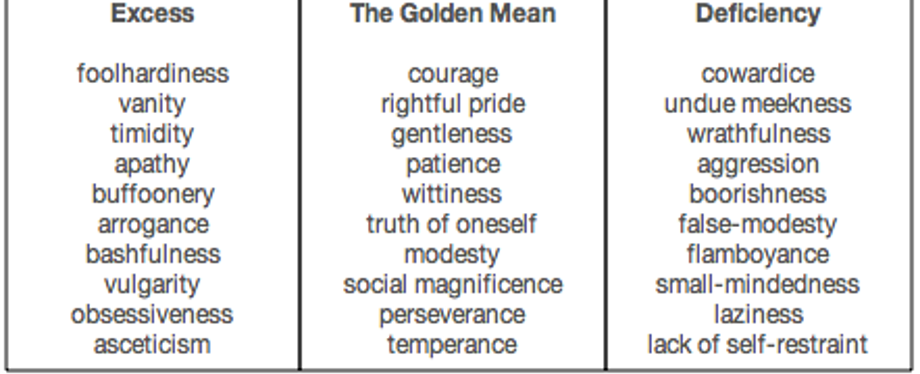
And not to get too lost in the weeds, but the question becomes, what actions would a person of excellence do? It is not, what are the deeds that make a person excellence. Character comes first.
And this excellence is where flourishing comes in.
A Flutist, A Sculptor, A Human
Aristotle uses the following illustration.
For just as for a flute-player, a sculptor, or any artist, and, in general, for all things that have a function or activity, the good and the ‘well’ are thought to reside in the function…NE I.7, 1097b25–27)
“…and the function of a good person is to perform this well.” NE I.7, 1098a15)
Thinking of the flute of the flute player. A poor flute will not reveal the capacities of a great flautist. A tremendous flute will not make a novice sound like a maestro/maestra but will provide those capacities to be cultivated.
Beginning with the flute the flutist (sidenote: why are there multiple correct ways to write a flute-player, i.e, as a flautist, or as a flutist?) has, rather than with the person, is where Aristotle begins. A poor flute will not reveal the capacities of a great flautist. A tremendous flute will not make a novice sound like a maestro but will provide those capacities to be cultivated. Conversely, a poorly constructed flute can make a maestra sound mediocre.
Sandel (Sandel, 209) writes
"The true value of our contribution cannot be measured by the wage we receive, for wages depend... on contingencies of supply and demand. The value of our contribution depends instead on the moral and civic importance of the ends our efforts serve."
Aristotle is not really talking about music. Rather, the point is a human life is good when its distinctive capacities are actively and excellently lived. And, when those capacities are provided ample resources necessary for reaching their ultimate levels of excellence. Rather than a flute and a flautist, we’re talking about neighbors, fellow-citizens, coworkers. We can add clean air and water, access to healthcare, and education. Perhaps the whole pyramid of Maslow’s hierarchy of needs. The good life is about a life that generate more virtue, and more good.
Build Purpose on Purpose
Aristotle’s idea of a “final cause” is about purpose—the reason something exists. For leaders, the final cause isn’t control or authority, but guiding others toward shared meaning. He wrote, “He who cannot live in society, or who has no need because he is sufficient for himself, must be either a beast or a god” (Politics, 1.2, 1253a27; trans. Reeve, 1998). Aristotle, using those attributions of “beast or a god,” creatively points to one and the same kind of person. Leadership is about building community, not standing alone. In a conflicted world, there are plenty ascribing to themselves some kind of divine right; but actually, demonstrate beastly aspirations.
Providing Better Flutes for Human Flourishing
Aristotle’s philosophy can feel abstract, but leaders can apply it in simple ways. The hardest question to sit with is the question of human flourishing.
Connect work to purpose: Regularly remind your team why not just their work matters, but those with whom they work, and those who receive the product or service. Link daily tasks to the greater themes and values.
Foster growth: Give people chances to learn and make choices. Support professional development and celebrate progress. But, like Aristotle is suggesting, make sure they have the good tools to access these.
Build community: Create a culture of respect and inclusion. Encourage collaboration and recognize everyone’s contributions. The concept of virtue is not at the expense of others (contrary to utilitarian and sometimes deontological ideals).
Embrace diversity: Seek out different perspectives. Make sure all voices are heard, especially those who are often overlooked. Injustice for one is injustice for all, we are all connected. And those who are marginalized are often the most dramatic example of the injustices we placate. If some are not flourishing, no one is.
(Note: While living in a misogynistic time that justified enslavement of human beings and the abuse and domination of others, Aristotle, unbeknownst to him, began laying the groundwork for liberty and equity. But that would take a while.)
Aristotle. (1999). Nicomachean Ethics (Trans. Terence Irwin). Hackett Publishing. (Original work published ca. 350 BCE)
Sandel, M. J. (2020). The tyranny of merit: What's become of the common good? Farrar, Straus and Giroux